Portal: A Cross-Platform Creative Workspace
Independent creatives rarely develop ideas in a single place. A melody might begin as a voice memo, lyrics live in Notes, visual references are saved to Pinterest or screenshots, and feedback happens through messages or conversations.
Portal is a tool that supports the creative process, leaving creators to remember where ideas lived and manually reconnect them as projects evolved.
We explored how a digital platform could bring these fragmented pieces together, giving musicians and artists a shared space to capture, organize, connect, and develop creative ideas without imposing a rigid workflow.
The concept allows creators to document early inspiration, connect related ideas and references, build on them over time, and collaborate with other creatives as projects take shape.
Year
2026
Client
Barnes & Noble
Website
https://www.barnesandnoble.com/
The Challenge
Creative work is inherently fragmented.
Participants described moving between voice recordings, Notes, Pinterest, reference images, physical notebooks, messaging apps, and specialized creative software.
The problem wasn't necessarily that these tools were bad.
It was that each tool captured only one part of the creative process.
A melody might exist in a voice memo while lyrics live in Notes. Visual inspiration could be scattered across Pinterest and screenshots. Feedback might happen through messages or informal conversations.
As projects evolved, creators had to remember where everything lived and manually reconstruct the relationships between ideas.
How might we help independent creatives capture, organize, connect, and develop ideas without forcing their creative process into a rigid workflow?
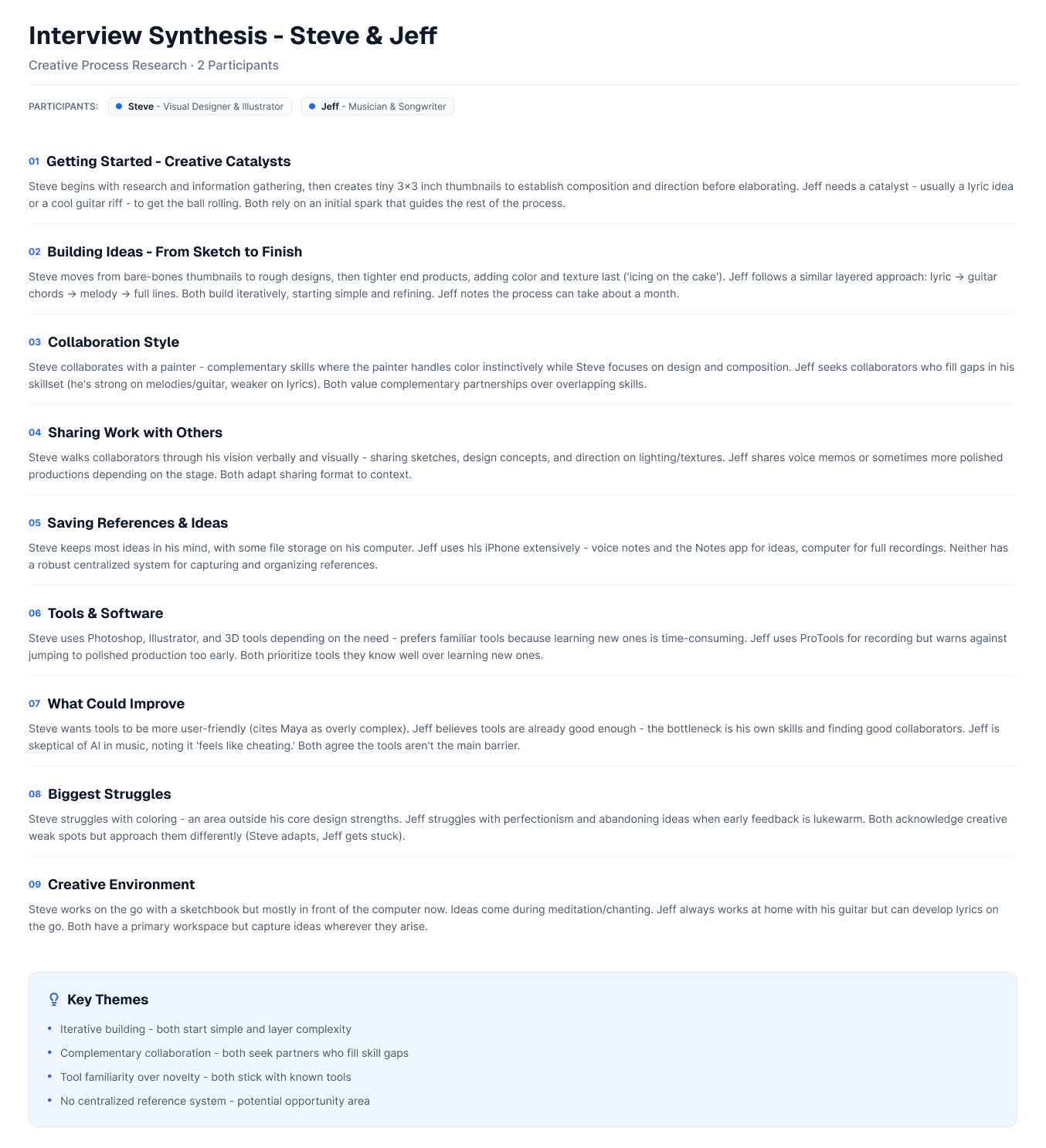
I conducted in-depth interviews with three creative professionals whose work spans music, visual design, and multidisciplinary creative practice.
Rather than asking participants what features they wanted, I focused on understanding how creative work actually happens.
Participants
Jeff: Musician
Creates through songwriting, recording, and collaboration
Steve: Animator & Musician
Works across visual design and music, frequently collaborating with others.
Amanda: Multidisciplinary Artist
Works across different creative mediums and sources of inspiration.
Discovery goals
The interviews followed the full creative lifecycle:
Where ideas first come from
How inspiration is captured
How unfinished ideas are stored
How concepts develop over time
How collaborators become involved
How creative work is shared
How feedback affects the process
What causes creative blocks
Which tools creators rely on
Where existing workflows break down
This allowed me to look beyond individual tools and understand the system surrounding creative work.

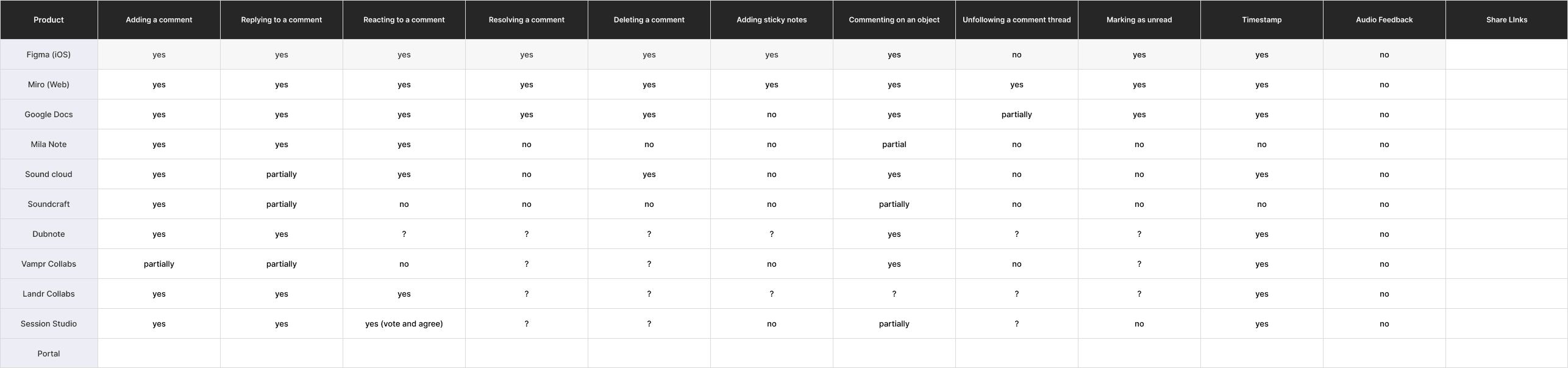
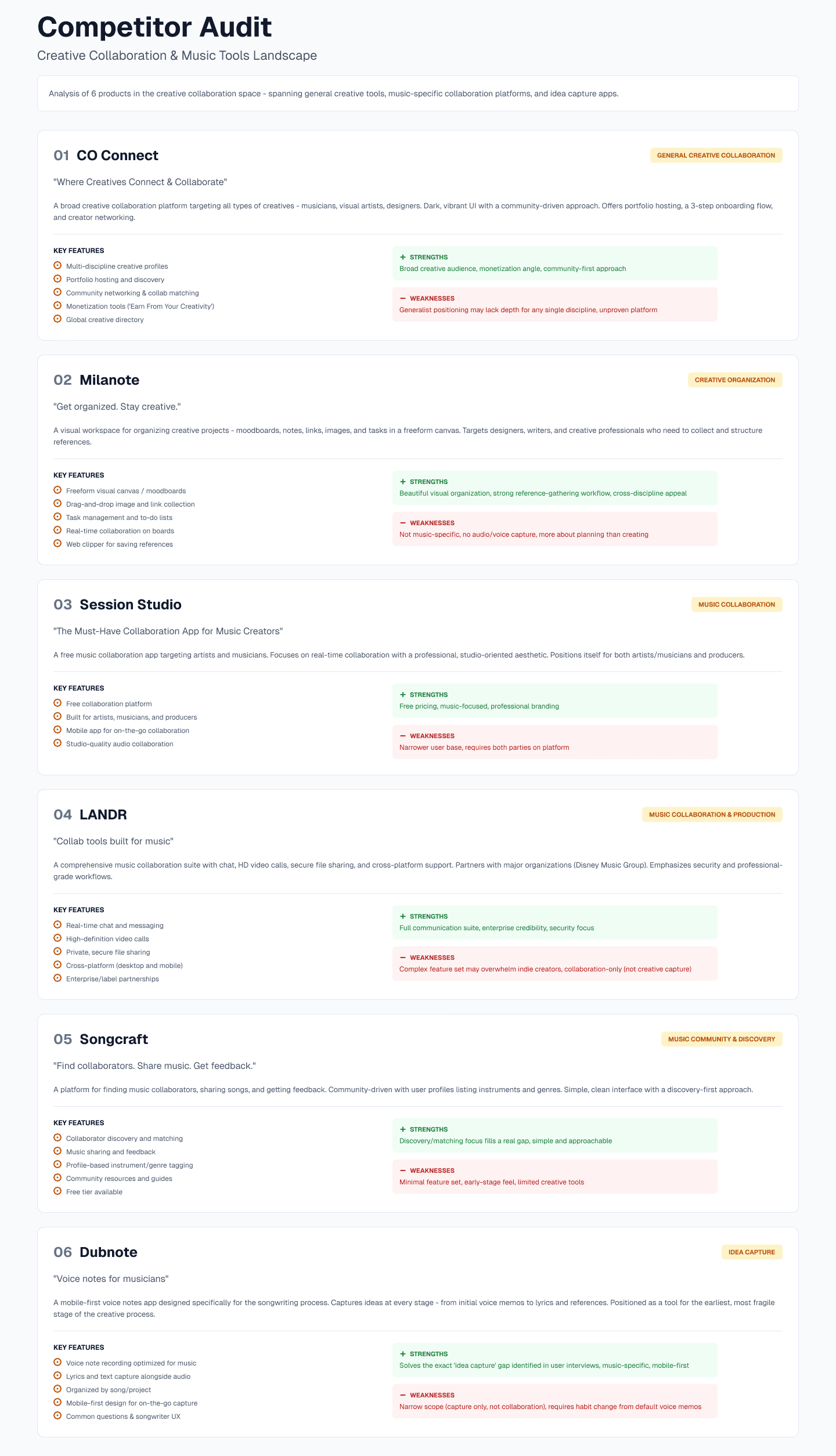
Competitive Analysis

From Findings to Opportunity Areas
The research pointed toward three areas where a product could meaningfully support creative work.
Connect fragmented ideas
Create a central place where recordings, notes, sketches, images, references, and unfinished concepts can coexist.
Make relationships between ideas visible
Instead of organizing everything through folders and lists, allow creators to visually connect related fragments and see how ideas evolve.
Support collaboration without making it mandatory
Let creators develop ideas privately and invite collaborators when they reach a point where another perspective or skill would help.
Defining the Problem
Three core problems emerged from the research.
Ideas disappear
Creative ideas are fleeting.
People capture them quickly in whatever tool is nearby, which means ideas become distributed across notes, recordings, screenshots, bookmarks, and notebooks.
Finding them later becomes difficult.
Ideas rarely evolve in a straight line
Traditional productivity tools assume relatively structured workflows.
Creative thinking doesn't.
Ideas branch, reconnect, disappear, return months later, and sometimes become part of entirely different projects.
Independent creativity can become isolating
Participants valued collaboration, but collaboration usually happened informally through existing relationships.
There was an opportunity to make collaboration easier without turning the experience into another social network.
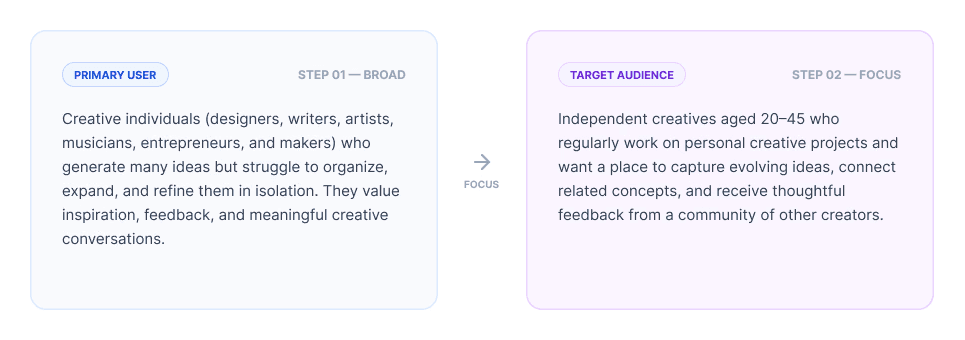
Independent creatives need a flexible way to capture, connect, and develop fragmented ideas because creative thinking is nonlinear, existing tools separate related artifacts, and collaboration often happens outside the tools where the work itself lives.


Product Direction
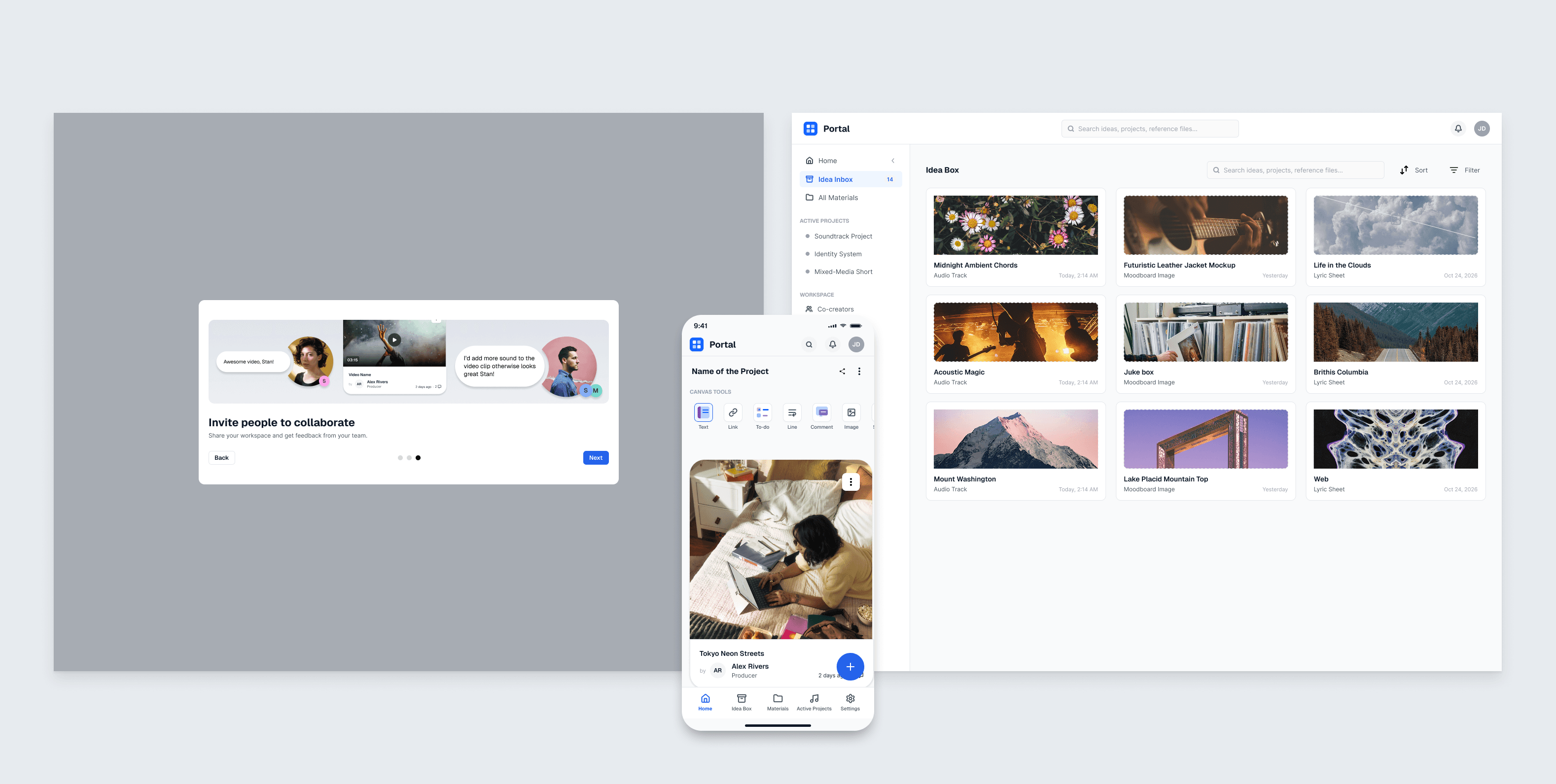
Creative Companion became a concept for a visual creative workspace where ideas can begin as small fragments and gradually develop into projects. Instead of requiring users to immediately create folders, projects, tasks, and structured documents, the workspace allows ideas to exist before creators know what they will become.
Designing the Experience
The research changed the way I thought about the product.
My initial instinct was to think in terms of projects and collaboration.
The interviews suggested something different:
The product needed to begin before a project exists.
A creator might only have:
A recording.
A sentence.
A photograph.
A chord.
A sketch.
A reference.
That fragment should be enough to start.

Experience Principles
I used four principles to guide the concept.
Capture first. Organize later.
Users shouldn't have to decide where something belongs before saving it.
Make connections visible.
Relationships between ideas should be spatial and visual rather than hidden inside folder structures.
Preserve unfinished work.
The workspace should feel comfortable for rough ideas, experiments, and incomplete concepts — not just polished outcomes.
Collaboration should happen when it adds value.
Creators should be able to work privately, invite specific people, or potentially look for complementary collaborators.
Concept Development
From these principles, I explored a visual workspace built around creative fragments.
Each fragment could represent a different medium:
Voice recording
Written note or lyric
Sketch
Image
Video
Reference
Link
Task
Creative file
Instead of existing independently, fragments could be arranged and connected on a flexible canvas.
Over time, clusters of fragments could naturally become projects.


Core Experience
01: Capture
Creators can quickly add an idea without creating a formal project first.
The goal is to reduce the distance between having an idea and preserving it.
02: Connect
Ideas can be positioned visually and linked to related references, recordings, notes, or concepts.
This creates a visual representation of how the creator is thinking rather than forcing everything into a predetermined hierarchy.
03: Develop
As an idea grows, creators can add new material, tasks, versions, and references.
A simple fragment can gradually become a structured creative project.
04: Collaborate
When creators need another perspective or skill, they can invite someone directly into the work.
Collaboration happens around the creative context, not just the final file.
05: Revisit
Version history and relationships between ideas allow creators to understand how a project evolved and rediscover concepts that might otherwise have been forgotten.

The Collaboration Question
One important question remained unresolved during the research:
Should Creative Companion primarily support collaboration with people creators already know, or should it also help them discover new collaborators?
The interviews provided evidence for both directions.
Participants already relied on trusted creative relationships, suggesting private collaboration should remain central.
At the same time, difficulty finding people with complementary skills appeared as a genuine constraint.
Rather than immediately turning the product into a social network, I would test a more focused hypothesis:
Would creators value being able to request a specific creative skill from the community from within an existing project?
For example:
Looking for: vocalist
Project: Summer Song
Stage: Early concept
Need: Help developing vocals for the chorus
This keeps discovery tied to an actual creative need rather than generic networkin

Measuring Success
Because Creative Companion is a concept rather than a launched product, I would avoid claiming business outcomes that haven't happened.
Instead, the next phase would validate whether the proposed experience actually improves the creative workflow.
I would measure:
Capture success — Can users save a new idea quickly without deciding how to organize it first?
Retrievability — Can users return later and find previously captured ideas?
Connection — Do users understand how to relate recordings, notes, images, and references?
Project development — Can users turn loose fragments into a more developed body of work without restructuring everything?
Collaboration — Can users understand when and how to invite another person into the creative process?
The most important qualitative signal would be whether creators feel that the workspace supports their existing way of thinking rather than forcing them into a new one.